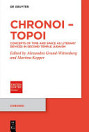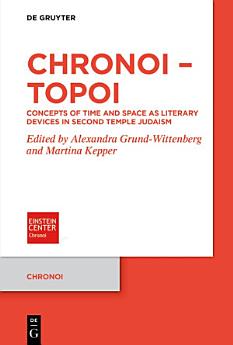
Chronoi – Topoi: Concepts of Time and Space as Literary Devices in Second Temple Judaism
Alexandra Grund-Wittenberg · Martina Kepper
Aug 2026 · Chronoi Book 24 · Walter de Gruyter GmbH & Co KG
Ebook
206
Pages
Tools
info
About this ebook
Jewish authoritative writings of the Second temple Period had to adopt to total different religious as well as political circumstances their adressees had to face. Inspired by the idea of Paul Kosmin, that the imposture of a total new imperial time regime by the Seleucid rulers provoked autochthonous reorientations in means of time and space, the contributions of this volume examine if this holds true to the writings that circulated during the contemporary Second Temple Period. The methodological approach for the examination is the concept of space-time, or chronotope, already developed by Michail Bakthin for 20th century literature. Focusing on Judaism of the Second Temple turned out to be very fruitful, as we can distinguish between distinct religious-sociologically formed Jewish groups under different spatial conditions (for example “diaspora” vs. core land). They all produced literature in order to cope with the traumatizing experiences of the loss of sacred spaces as well as the transformation processes that, due to the loss of “Jerusalem” as the spatial anchor point, endangered their religious and national identity. Documents of so-called Hellenistic Judaism in the form of the Septuagint as well as of Palestinian Judaism, which becomes tangible in the texts of Qumran, or in the texts of Elephantine all show signs of increased interest in temporal and spatial orientation, remembering or adopting the already known, as well as inventing new anchor points as their special “chronotope”. In sum, by establishing their own chronotopes, Judaism in Persian and Hellenistic-Roman times gained resilience and developed strategies to redefine its own identity.
Jewish authoritative writings of the Second temple Period had to adopt to total different religious as well as political circumstances their adressees had to face. Inspired by the idea of Paul Kosmin, that the imposture of a total new imperial time regime by the Seleucid rulers provoked autochtho...
Discover more
About the author
Alexandra Grund-Wittenberg, Philipps-Universität Marburg, Germany; Martina Kepper, Philipps-Universität Marburg, Germany.
Alexandra Grund-Wittenberg, Philipps-Universität Marburg, Germany; Martina Kepper, Philipps-Universität Marburg, Germany.
Rate this ebook
Tell us what you think.
Reading information
Smartphones and tablets
Install the Google Play Books app for Android and iPad/iPhone. It syncs automatically with your account and allows you to read online or offline wherever you are.
Laptops and computers
You can listen to audiobooks purchased on Google Play using your computer's web browser.
eReaders and other devices
To read on e-ink devices like Kobo eReaders, you'll need to download a file and transfer it to your device. Follow the detailed Help Center instructions to transfer the files to supported eReaders.