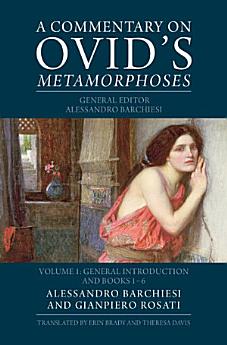
A Commentary on Ovid's Metamorphoses: Volume 1, General Introduction and Books 1-6
About this ebook
Discover more
About the author
ALESSANDRO BARCHIESI is a professor of Classics at New York University, after teaching at Stanford and the University of Siena. He has been visiting professor at Berkeley and Harvard, and his activity as a lecturer includes the Sather Classical Lectures at Berkeley (2011), the Nellie Wallace Lectures at Oxford (1997), the Gray Lectures at Cambridge (2001), the Jerome Lectures (AAR/University of Michigan, 2002), the Housman Lecture at UC London (2009), and the Martin Lectures at Oberlin (2012). His work combines close reading of Roman literary texts (poetry and fiction) with interest in contemporary criticism, literary theory, and reception history. He is author of inter alia a commentary on Ovid's Heroides 1-3 (1992) and the Ovidian volumes of essays The Poet and the Prince (1997) and Speaking Volumes (2001), and co-editor with W. Scheidel of the Oxford Handbook of Roman Studies (2nd ed. 2020). His forthcoming work includes The War for Italia and Apuleius the Provincial.
GIANPIERO ROSATI is Emeritus Professor of Latin Literature at the Scuola Normale Superiore, Pisa, where he has also served as Dean of the Faculty of Humanities. He works on Augustan poetry, in particular on Ovid (with essays, editions and commentaries), the literature of the Neronian and Flavian ages, and Latin narrative. His early book Narciso e Pigmalione. Illusione e spettacolo nelle Metamorfosi di Ovidio (1983; English translation 2021) has influenced more recent developments of Ovidian criticism, such as the emphasis on illusion and the Roman culture of spectacle and the relationship between art, landscape, and text. He is also a leading scholar of the Heroides, having published various studies and a commentary on the letters of Hero and Leander (1997). He has written on all the most important Augustan poets (and some minors), on Petronius and on Apuleius. His more recent research concerns the poetry of Statius, particularly the poetics of occasional lyric in the Silvae. He is currently working on a commentary on Statius' Silvae in the Fondazione Valla series.