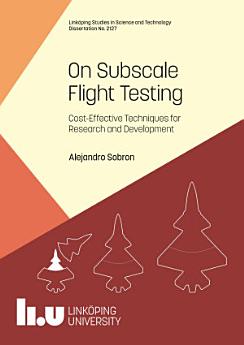
On subscale flight testing: Cost-effective techniques for research and development

· Linköping Studies in Science and Technology. Dissertations Book 2127 · Linköping University Electronic Press
Ebook
128
Pages

About this ebook

Experiments with downscaled or subscale physical models have traditionally been an essential source of information in aerospace research and development. Physical models are very effective at revealing unforeseen issues and providing confidence in design predictions or hypotheses. While computational methods are predominant nowadays, experimental methods such as wind-tunnel testing still play a critical role as verification and calibration tools. However, wind-tunnel testing is often too expensive, too slow or unavailable during aircraft conceptual design or the early development of immature technologies. It is here that testing free-flight subscale models - referred to as subscale flight testing (SFT) - could be an affordable and low-risk complementary method for obtaining both qualitative and quantitative information.

Disruptive technological innovations have significantly altered both the cost and the capabilities of SFT during recent decades. Such innovations include the price performance of miniaturised electronics and communication systems, advances in rapid prototyping techniques and materials, the availability of specialised components from the booming drone market and the rapid development of open-source software and hardware, allowing for sophisticated and capable test platforms at a fraction of the cost compared to a few decades ago. It is therefore necessary to re-evaluate the benefits and limitations of SFT, as well as its role in contemporary aircraft design and technology development processes.

This dissertation aims to contribute to knowledge on the use of the SFT method for research and development, focusing on low-cost, time-efficient solutions that are particularly suitable for small organisations and limited resources. The method’s challenges, needs and limitations are identified through a critical study of the physical similarity principles, an in-depth review of the experiences of other organisations, and practical field experiments with different subscale models in real conditions. Some of the proposed solutions include a low-cost data acquisition system with custom-made instruments, a novel method for automatic execution of excitation manoeuvres, specific techniques and parameter-identification methods for flight testing in confined airspaces, and a set of tools for the analysis and visualisation of flight data. The obtained results may serve as proof of the current possibilities to evaluate and demonstrate new technology through SFT using very limited economic and human resources.
Experiments with downscaled or subscale physical models have traditionally been an essential source of information in aerospace research and development. Physical models are very effective at revealing unforeseen issues and providing confidence in design predictions or hypotheses. While computati...

Discover more

Rate this ebook

Tell us what you think.

Reading information

Smartphones and tablets
Install the Google Play Books app for Android and iPad/iPhone. It syncs automatically with your account and allows you to read online or offline wherever you are.
Laptops and computers
You can listen to audiobooks purchased on Google Play using your computer's web browser.
eReaders and other devices
To read on e-ink devices like Kobo eReaders, you'll need to download a file and transfer it to your device. Follow the detailed Help Center instructions to transfer the files to supported eReaders.