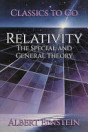
Sidelights on Relativity: Restored Classics to Go Edition

· Otbebookpublishing
Ebook
35
Pages
Eligible

About this ebook

Einstein's luminous scientific essay begins with a question that once haunted physics: if forces act across empty space, what fills the gap? From Newton's gravity to the wave nature of light, polarization, Maxwell's fields, Hertz's experiments, and Lorentz's refinements, he traces the rise and collapse of the luminiferous ether, showing how each theory tried to reconcile matter, electricity, and the electromagnetic field. Special relativity seems to banish ether altogether, yet Einstein argues instead for a deeper redefinition: space is not merely empty extension, but a physical structure with real properties, especially in the framework of general relativity. From there he turns to geometry, measurement, and the cosmos. Pure mathematics gains certainty only as formal axiomatics, while practical geometry must answer to rods, clocks, light, and experience. Euclidean assumptions give way to Riemannian space-time, and the universe itself may be finite yet unbounded, like a spherical surface with no edge. Along the way, Einstein asks whether gravity and electromagnetism can be unified, and whether quantum theory sets limits on that dream. This edition has been fully restored with modern typesetting, custom cover design.
Einstein's luminous scientific essay begins with a question that once haunted physics: if forces act across empty space, what fills the gap? From Newton's gravity to the wave nature of light, polarization, Maxwell's fields, Hertz's experiments, and Lorentz's refinements, he traces the rise and co...

Discover more

About the author

Albert Einstein was born in 1879 in Ulm, Germany, and went on to become one of the most influential scientific thinkers of the modern age, reshaping how humanity understands space, time, gravity, and the structure of the universe. After studying in Switzerland and working at the Swiss Patent Office, he rose to international prominence through a series of revolutionary theoretical insights that transformed physics and earned him the Nobel Prize in 1921. Though best known as a scientist rather than a literary figure, Einstein also wrote with unusual clarity and humanity, using essays and reflective prose to explain complex ideas to general readers and to explore the relationship between science, philosophy, and society. His writing often returns to themes of curiosity, imagination, intellectual humility, and the ethical responsibilities of knowledge, making his work feel strikingly current in an age shaped by rapid technological change and public debate about science. Einstein's legacy endures not only in the equations that bear his name but in his belief that understanding the universe should also deepen our sense of wonder, responsibility, and connection to others. Readers who enjoy big ideas, lucid explanation, and thoughtful reflections on the meaning of scientific discovery will find him especially rewarding.
Albert Einstein was born in 1879 in Ulm, Germany, and went on to become one of the most influential scientific thinkers of the modern age, reshaping how humanity understands space, time, gravity, and the structure of the universe. After studying in Switzerland and working at the Swiss Patent Offi...

Rate this ebook

Tell us what you think.

Reading information

Smartphones and tablets
Install the Google Play Books app for Android and iPad/iPhone. It syncs automatically with your account and allows you to read online or offline wherever you are.
Laptops and computers
You can listen to audiobooks purchased on Google Play using your computer's web browser.
eReaders and other devices
To read on e-ink devices like Kobo eReaders, you'll need to download a file and transfer it to your device. Follow the detailed Help Center instructions to transfer the files to supported eReaders.