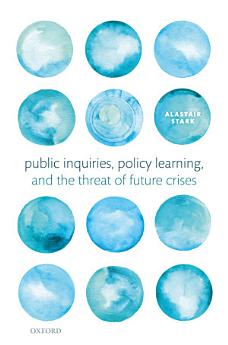
Public Inquiries, Policy Learning, and the Threat of Future Crises
Nov 2018 · Oxford University Press
Ebook
240
Pages
Tools
info
family_home
Eligible
info
About this ebook
In the aftermath of major crises governments turn to public inquiries to learn lessons. Inquiries often challenge established authority, frame heroes and villains in the public spotlight and deliver courtroom-like drama to hungry journalists. As such, they can become high-profile political stories in their own right. Inquiries also have a policy learning mandate with big implications because they are ultimately responsible for identifying policy lessons which, if implemented, should keep us safe from the next big event. However, despite their high-profile nature and their position as the pre-eminent means of learning about crises, we still know very little about what inquiries produce in terms of learning and what factors influence their effectiveness in this regard. In light of this, the question that animates this book is as important as it is simple. Can post-crisis inquiries deliver effective lesson-learning which will reduce our vulnerability to future threats? Conventional wisdom suggests that the answer to this question should be an emphatic no. Outside of the academy, for example, inquiries are regularly vilified as costly wastes of time that illuminate very little while inside social scientists echo similar concerns, regularly describing inquiries as unhelpful. These commentaries, however, lack robust, generalizable evidence to support their claims. This volume provides evidence from the first international comparison of post-crisis inquiries in Australia, Canada, New Zealand, and the United Kingdom, which shows that, contrary to conventional wisdom, the post-crisis inquiry is an effective means of policy learning after crises and that they consistently encourage policy reforms that enhance our resilience to future threats.
In the aftermath of major crises governments turn to public inquiries to learn lessons. Inquiries often challenge established authority, frame heroes and villains in the public spotlight and deliver courtroom-like drama to hungry journalists. As such, they can become high-profile political storie...
Discover more
About the author
Alastair Stark is a Lecturer in Public Policy at the University of Queensland. His recent publications include Risk and Crisis Management in the Public Sector (with A McConnell and L Drennan, Routledge, 2015).
Alastair Stark is a Lecturer in Public Policy at the University of Queensland. His recent publications include Risk and Crisis Management in the Public Sector (with A McConnell and L Drennan, Routledge, 2015).
Rate this ebook
Tell us what you think.
Reading information
Smartphones and tablets
Install the Google Play Books app for Android and iPad/iPhone. It syncs automatically with your account and allows you to read online or offline wherever you are.
Laptops and computers
You can listen to audiobooks purchased on Google Play using your computer's web browser.
eReaders and other devices
To read on e-ink devices like Kobo eReaders, you'll need to download a file and transfer it to your device. Follow the detailed Help Center instructions to transfer the files to supported eReaders.