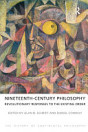
Nineteenth-Century Philosophy: Revolutionary Responses to the Existing Order
Sep 2014 · Routledge
star
1 review
Ebook
334
Pages
family_home
Eligible
info
About this ebook
The second half of the 19th Century saw a revolution in both European politics and philosophy. Philosophical fervour reflected political fervour. Five great critics dominated the European intellectual scene: Ludwig Feuerbach, Karl Marx, Soren Kierkegaard, Fyodor Dostoevsky, and Friedrich Nietzsche. "Nineteenth-Century Philosophy" assesses the response of each of these leading figures to Hegelian philosophy - the dominant paradigm of the time - to the shifting political landscape of Europe and the United States, and also to the emerging critique of modernity itself. Both individually and collectively, these thinkers succeeded in revolutionizing theology, philosophy, psychology, and politics. The period also saw the emergence of new schools of thought and new disciplinary thinking. The volume covers the birth of sociology and the social sciences, the development of French spiritualism, the beginning of American pragmatism, the rise of science and mathematics, and the maturation of hermeneutics and phenomenology.
The second half of the 19th Century saw a revolution in both European politics and philosophy. Philosophical fervour reflected political fervour. Five great critics dominated the European intellectual scene: Ludwig Feuerbach, Karl Marx, Soren Kierkegaard, Fyodor Dostoevsky, and Friedrich Nietzsch...
Ratings and reviews
1 review
Rate this ebook
Tell us what you think.
Reading information
Smartphones and tablets
Install the Google Play Books app for Android and iPad/iPhone. It syncs automatically with your account and allows you to read online or offline wherever you are.
Laptops and computers
You can listen to audiobooks purchased on Google Play using your computer's web browser.
eReaders and other devices
To read on e-ink devices like Kobo eReaders, you'll need to download a file and transfer it to your device. Follow the detailed Help Center instructions to transfer the files to supported eReaders.