Información sobre este eBook
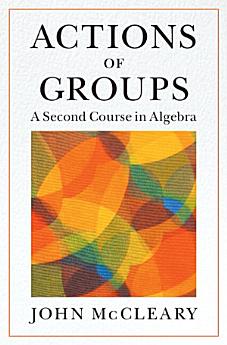
Using the unifying notion of group actions, this second course in modern algebra introduces the deeper algebraic tools needed to get into topics only hinted at in a first course, like the successful classification of finite simple groups and how groups play a role in the solutions of polynomial equations. Because groups may act as permutations of a set, as linear transformations on a vector space, or as automorphisms of a field, the deeper structure of a group may emerge from these viewpoints, two different groups can be distinguished, or a polynomial equation can be shown to be solvable by radicals. By developing the properties of these group actions, readers encounter essential algebra topics like the Sylow theorems and their applications, Galois theory, and representation theory. Warmup chapters that review and build on the first course and active learning modules help students transition to a deeper understanding of ideas.
Using the unifying notion of group actions, this second course in modern algebra introduces the deeper algebraic tools needed to get into topics only hinted at in a first course, like the successful classification of finite simple groups and how groups play a role in the solutions of polynomial e...
Descubre más
Acerca del autor
John McCleary is Professor of Mathematics on the Elizabeth Stillman Williams Chair at Vassar College. He received his Ph.D. in mathematics from Temple University, where he completed a thesis on algebraic topology under the direction of James Stasheff. The author of several books, including A User's Guide to Spectral Sequences and Geometry from a Differentiable Viewpoint, McCleary has published extensively on topology, the history of mathematics, and other topics. His current research focuses on algebraic topology – specifically, where algebra reveals what topology may conceal.
John McCleary is Professor of Mathematics on the Elizabeth Stillman Williams Chair at Vassar College. He received his Ph.D. in mathematics from Temple University, where he completed a thesis on algebraic topology under the direction of James Stasheff. The author of several books, including A User...
Valorar este eBook
Danos tu opinión.
Información sobre cómo leer
Smartphones y tablets
Instala la aplicación Google Play Libros para Android y iPad/iPhone. Se sincroniza automáticamente con tu cuenta y te permite leer contenido online o sin conexión estés donde estés.
Ordenadores portátiles y de escritorio
Puedes usar el navegador web del ordenador para escuchar audiolibros que hayas comprado en Google Play.
eReaders y otros dispositivos
Para leer en dispositivos de tinta electrónica, como los lectores de libros electrónicos de Kobo, es necesario descargar un archivo y transferirlo al dispositivo. Sigue las instrucciones detalladas del Centro de Ayuda para transferir archivos a lectores de libros electrónicos compatibles.