About this ebook
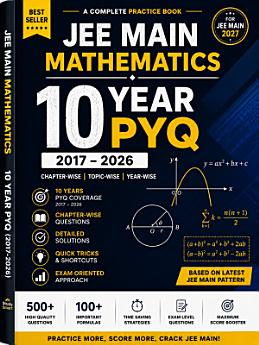
MASTER JEE MAIN MATHS TRICK BANK2017–2026 jee • MCQs • Solutions • Quick Tricks
Important: This is an original PYQ-pattern practice book. It is not a verbatim reproduction of NTA/JEE Main question papers.
Fast Calculation • Algebra • Squares • Trigonometry • Calculus • Coordinate Geometry
1. Square ending in 5
For n5², multiply n by n+1 and append 25. Example: 35² = 3×4 | 25 = 1225.
2. Square of a number near 100
Use (100±a)² = 10000 ± 200a + a². Example: 97² = 10000−600+9 = 9409.
3. Square of a number near 50
Use (50±a)² = 2500 ± 100a + a². Example: 47² = 2500−300+9 = 2209.
4. Difference of squares
a²−b²=(a−b)(a+b). Use this before expanding.
5. (a+b)² shortcut
a²+b²+2ab. If a+b and ab are known, directly get a²+b²=(a+b)²−2ab.
6. (a−b)² shortcut
a²+b²−2ab. Therefore a²+b²=(a−b)²+2ab.
7. Reciprocal square
If x+1/x=k, then x²+1/x²=k²−2.
8. Cube reciprocal
If x+1/x=k, then x³+1/x³=k³−3k.
9. AM-GM minimum
For positive x, x+a/x ≥ 2√a. Equality occurs at x=√a.
10. Quadratic minimum
For ax²+bx+c, vertex x=−b/(2a). Complete the square when possible.
11. Divisibility by 3
A number is divisible by 3 if the sum of its digits is divisible by 3.
12. Divisibility by 9
Same idea as 3, but the digit sum must be divisible by 9.
13. Divisibility by 11
Difference between alternating digit sums must be 0 or a multiple of 11.
14. HCF × LCM
For two positive integers a,b: HCF(a,b)×LCM(a,b)=ab.
15. AP nth term
a_n=a+(n−1)d. Write this first before substituting.
16. AP sum
S_n=n/2[2a+(n−1)d] or n/2(first+last).
17. GP nth term
a_n=ar^(n−1).
18. GP sum
For r≠1, S_n=a(r^n−1)/(r−1).
19. Binomial coefficient
Coefficient of x^r in (1+x)^n is nCr.
20. nCr relation
nCr = nC(n−r). Choose the smaller r for faster calculation.
21. Determinant 2×2
For |a b; c d|, determinant = ad−bc.
22. Straight-line slope
m=(y₂−y₁)/(x₂−x₁). Vertical line has undefined slope.
23. Distance from axes
Distance from x-axis = |y|; distance from y-axis = |x|.
24. Circle recognition
(x−h)²+(y−k)²=r² gives centre (h,k) and radius r.
25. Parabola recognition
y²=4ax opens right if a>0; x²=4ay opens upward if a>0.
26. Complex modulus
|a+bi|²=a²+b². Avoid taking the square root if only |z|² is asked.
27. Powers of i
i, −1, −i, 1 repeat every 4 powers.
28. Trigonometric identity
sin²x+cos²x=1. Convert one into the other immediately.
29. Double angle
sin2x=2sinx cosx; cos2x=1−2sin²x=2cos²x−1.
30. Standard values
Remember 0°, 30°, 45°, 60°, 90° values before attempting lengthy manipulation.
31. Limit by factorisation
If direct substitution gives 0/0 for x²−a², factor as (x−a)(x+a).
32. Derivative power rule
d(x^n)/dx=nx^(n−1).
33. Chain rule
For f(g(x)), differentiate the outside and multiply by derivative of the inside.
34. Integration power rule
∫x^n dx=x^(n+1)/(n+1)+C, n≠−1.
35. Definite integral
Find an antiderivative, then substitute upper limit minus lower limit.
36. Differential-equation order
Order = highest derivative present; degree is different and needs the equation to be polynomial in derivatives.
37. Vector dot product
a·b=|a||b|cosθ. If dot product is 0, non-zero vectors are perpendicular.
38. Vector magnitude
|a|=√(a₁²+a₂²+a₃²).
39. Probability complement
P(A')=1−P(A).
40. Conditional probability
P(A|B)=P(A∩B)/P(B), when P(B)>0.
41. Independent events
If A and B are independent, P(A∩B)=P(A)P(B).
42. Mean of consecutive numbers
For equally spaced consecutive values, mean = (first+last)/2.
43. Fast option elimination
Check sign, range, units/dimensions (where applicable), and obvious bounds before full calculation.
44. Range check
sinx and cosx lie in [−1,1]. Therefore a sinx+b has range [b−|a|, b+|a|].
45. Modulus equation
|x|=a with a≥0 gives x=±a; if a<0 there is no real solution.
46. Log basics
log(ab)=log a+log b; log(a/b)=log a−log b; log(a^k)=k log a.
47. Exponential comparison
For a>1, a^x is increasing; for 0<a<1, it is decreasing.
48. Permutation vs combination
Arrangement/order matters ⇒ permutation. Selection/order does not ⇒ combination.
49. Symmetry in integrals
If f(x) is odd, ∫_{−a}^{a} f(x)dx=0. If f is even, it equals 2∫₀^a f(x)dx.
50. Exam-time rule
If a calculation is becoming long, first inspect identities, factorisation, bounds, symmetry, or option structure.
Discover more
Ratings and reviews

- Flag inappropriate

- Flag inappropriate

- Flag inappropriate