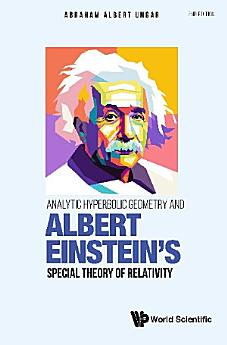
Analytic Hyperbolic Geometry and Albert Einstein's Special Theory of Relativity
About this ebook
Furthermore, the book presents, for the first time, the relativistic center of mass of an isolated system of noninteracting particles that coincided at some initial time t = 0. It turns out that the invariant mass of the relativistic center of mass of an expanding system (like galaxies) exceeds the sum of the masses of its constituent particles. This excess of mass suggests a viable mechanism for the formation of dark matter in the universe, which has not been detected but is needed to gravitationally "glue" each galaxy in the universe. The discovery of the relativistic center of mass in this book thus demonstrates once again the usefulness of the study of Einstein's special theory of relativity in terms of its underlying hyperbolic geometry.