About this ebook
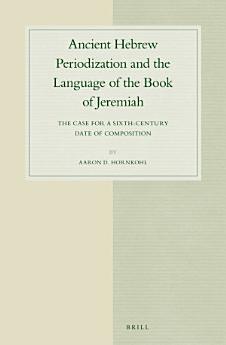
In Ancient Hebrew Periodization and the Language of the Book of Jeremiah, Aaron Hornkohl defends the diachronic approach to Biblical Hebrew and the linguistic dating of biblical texts. Applying the standard methodologies to the Masoretic version of the biblical book of Jeremiah, he seeks to date the work on the basis of its linguistic profile, determining that, though composite, Jeremiah is likely a product of the transitional time between the First and Second Temple Periods.
Hornkohl also contributes to unraveling Jeremiah’s complicated literary development, arguing on the basis of language that its 'short edition', as reflected in the book’s Old Greek translation, predates that 'supplementary material' preserved in the Masoretic edition but unparalleled in the Greek. Nevertheless, he concludes that neither is written in Late Biblical Hebrew proper.
Hornkohl also contributes to unraveling Jeremiah’s complicated literary development, arguing on the basis of language that its 'short edition', as reflected in the book’s Old Greek translation, predates that 'supplementary material' preserved in the Masoretic edition but unparalleled in the Greek. Nevertheless, he concludes that neither is written in Late Biblical Hebrew proper.
In Ancient Hebrew Periodization and the Language of the Book of Jeremiah, Aaron Hornkohl defends the diachronic approach to Biblical Hebrew and the linguistic dating of biblical texts. Applying the standard methodologies to the Masoretic version of the biblical book of Jeremiah, he seeks to date ...
Discover more
About the author
Aaron D. Hornkohl, Ph.D. (2012), The Hebrew University of Jerusalem, is a Research Associate in the Faculty of Asian and Middle Eastern Studies at the University of Cambridge.
Aaron D. Hornkohl, Ph.D. (2012), The Hebrew University of Jerusalem, is a Research Associate in the Faculty of Asian and Middle Eastern Studies at the University of Cambridge.
Rate this ebook
Tell us what you think.
Reading information
Smartphones and tablets
Install the Google Play Books app for Android and iPad/iPhone. It syncs automatically with your account and allows you to read online or offline wherever you are.
Laptops and computers
You can listen to audiobooks purchased on Google Play using your computer's web browser.
eReaders and other devices
To read on e-ink devices like Kobo eReaders, you'll need to download a file and transfer it to your device. Follow the detailed Help Center instructions to transfer the files to supported eReaders.