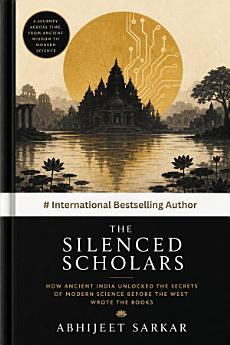
The Silenced Scholars: How Ancient India Unlocked the Secrets of Modern Science Before the West Wrote the Books
About this ebook
by Abhijeet Sarkar, CEO & Founder, Synaptic AI Lab
The history of science is a story you think you know. This book will prove you wrong.
What if the revolutionary ideas of the Renaissance and the Scientific Revolution were not born in Europe, but were echoes of a much older, silenced knowledge? What if the foundations of modern mathematics, medicine, and even computer science were fully developed in ancient India, thousands of years before the West wrote the books?
From Abhijeet Sarkar, CEO and Founder of the cutting-edge Synaptic AI Lab, comes a groundbreaking and meticulously researched exposé that will forever change how you see the history of human achievement. The Silenced Scholars is not another history book. It is a monumental reckoning with a past that has been systematically erased.
For centuries, a Eurocentric narrative has dominated our understanding of science, crediting giants like Copernicus, Newton, and Democritus. Sarkar challenges this orthodoxy, presenting undeniable evidence that ancient Indian scholars had already unlocked the very secrets that define our modern world.
In this explosive book, you will discover:
The Heliocentric Heresy: Long before Copernicus, astronomer Āryabhaṭa mapped a sun-centered solar system with breathtaking accuracy.
The Calculus That Wasn't: Uncover how the Kerala School of Mathematics developed the core concepts of calculus—differentiation, integration, and infinite series—centuries before Newton and Leibniz.
The Blueprint for Computing: See how the linguistic rules of Pāṇini's ancient grammar, the "Aṣṭādhyāyī," created the logical foundation that underpins modern computer programming languages.
The World's First Surgeon: Meet Suśruta, who was performing complex plastic surgery, cataract removal, and using over 120 surgical instruments in 600 BCE.
The Quantum Leap of Antiquity: Learn of Kaṇāda, who proposed a sophisticated atomic theory (paramāṇu) over 2,600 years ago.
The Nothing That Is Everything: Trace the true origin of the decimal system and the concept of zero (śūnya), the bedrock of all modern technology, and how it was transmitted—and its source obscured—by the West.
Sarkar takes you on a journey through time, revealing not only these incredible achievements but also the tragic story of why they were forgotten. He uncovers the deliberate suppression of Indian knowledge during the colonial era and the catastrophic destruction of ancient universities like Nālandā, a repository of wisdom lost to the world.
The Silenced Scholars is more than a historical account; it is a vital act of reclamation. It is a call to decolonize our curriculum, to challenge the stories we've been told, and to restore a silenced voice to its rightful place in the pantheon of human genius.
Ancient India, history of science, Indian history, Indian mathematics, decolonizing history, Āryabhaṭa, calculus, Suśruta, ancient surgery, Āyurveda, invention of zero, Pāṇini, Sanskrit grammar, computer science history, Eurocentrism, hidden history, Indic knowledge systems, Kerala School of Mathematics, ancient astronomy, Brahmagupta, Mádhava, Kaṇāda, ancient atomic theory, Indian metallurgy, Iron Pillar of Delhi, Nālandā University, suppressed knowledge, colonial history, scientific heritage of India, history of technology, popular science, ancient medicine, India's contribution to science.
The silence has been broken. The story of science is about to be rewritten. Click "Buy Now" to begin the journey and uncover the truth that was buried for centuries.
Discover more
Ratings and reviews
About the author
Abhijeet Sarkar, CEO & Founder of Synaptic AI Lab, stands as a modern polymath and philosopher whose intellectual voyages chart the often-turbulent confluence of technology, consciousness, and the future of human governance. His work is not a mere exploration of disparate fields but a deeply integrated synthesis, a testament to a mind that perceives the intricate web of connections binding the digital and the spiritual, the political and the personal. To categorize his literary and intellectual contributions in a straightforward manner would be to miss the very essence of his endeavor, which is to dissolve the artificial boundaries that have long segregated these critical domains of human thought.
At the helm of Synaptic AI Lab, Sarkar is more than a technologist or an entrepreneur; he is an architect of future dialogues. The very name of his organization hints at his core philosophy: the creation of new connections, new synapses in our collective understanding, mirroring the neural networks of the brain and the burgeoning intelligence of the artificial. His exploration of artificial intelligence transcends the mere mechanics of machine learning and deep learning. Instead, he plunges into the profound philosophical questions that a future with advanced AI necessitates. His writings are a compelling tapestry where the threads of code and consciousness are inextricably woven. He compels his readers to move beyond the simplistic narrative of AI as a mere tool and to confront it as a potential partner, a creator, and even a new form of consciousness, prompting a fundamental re-evaluation of our place in the universe.
In his literary pursuits, Sarkar masterfully blends the pragmatic with the philosophical, the immediate with the eternal. One does not simply read a book by Abhijeet Sarkar on AI; one engages in a discourse on the future of thought itself. His work on governance is not a dry treatise on policy and regulation but a vibrant reimagining of social contracts in an era of globalized digital existence. He intricately links the principles of transparent AI governance with the timeless quest for truth and ethical leadership, suggesting that the algorithms that will shape our future must be imbued with a profound understanding of human values. This is where his exploration of politics and globalization converges with his deep dive into the doctrines of our age, both seen and unseen. He challenges us to consider how global power structures will shift, not just through economic or military might, but through the control and dissemination of information by intelligent systems.
Sarkar's intellectual landscape is also fertile ground for the seeds of self-help and personal transformation, though not in the conventional sense. His guidance is not about superficial life hacks but about a deeper, more resonant alignment of the individual with the cosmos. He posits that in an age of technological acceleration, the greatest journey is the inward one. His writings on spirituality are not divorced from his technological explorations; rather, they are deeply intertwined. He sees the quest for artificial consciousness as a mirror reflecting our own still-nascent understanding of the human mind. In a world increasingly dominated by external stimuli and digital distractions, his work is a clarion call for introspection, for a cultivation of inner wisdom that can navigate the complexities of the 21st century and beyond.
The future, in Sarkar's vision, is not a predetermined destination but a fluid reality we are actively co-creating with our technological progeny. His writings on future tech are therefore not just predictive but also prescriptive. He outlines the potential pathways of development, from quantum computing to brain-computer interfaces, while simultaneously urging a collective, conscious choice in how we wield these powerful new tools. This is not the work of a futurist content with simply mapping possibilities, but of a philosopher deeply concerned with the moral and ethical signposts that should guide our journey.
Ultimately, at the core of Abhijeet Sarkar's multifaceted work lies a singular, unifying preoccupation: the nature of consciousness itself. Whether he is dissecting the architecture of a neural network, pondering the tenets of good governance, or exploring the depths of spiritual traditions, the fundamental question remains the same: what does it mean to be aware, to be sentient, to be human in a world that is rapidly becoming more than human? His writings are an invitation to this grand inquiry, a guidebook for the perplexed navigating the dawn of a new intellectual and existential era. He stands as a cartographer of the future, mapping not just the territories of technology, but the very contours of our evolving soul. Through his unique synthesis of the analytical and the intuitive, the scientific and the sacred, Abhijeet Sarkar is not just writing about the future; he is helping to write the future itself, one profound and interconnected thought at a time.