מידע על הספר הדיגיטלי הזה
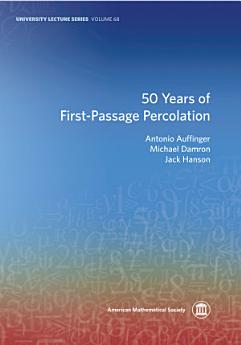
First-passage percolation (FPP) is a fundamental model in probability theory that has a wide range of applications to other scientific areas (growth and infection in biology, optimization in computer science, disordered media in physics), as well as other areas of mathematics, including analysis and geometry. FPP was introduced in the 1960s as a random metric space. Although it is simple to define, and despite years of work by leading researchers, many of its central problems remain unsolved.
In this book, the authors describe the main results of FPP, with two purposes in mind. First, they give self-contained proofs of seminal results obtained until the 1990s on limit shapes and geodesics. Second, they discuss recent perspectives and directions including (1) tools from metric geometry, (2) applications of concentration of measure, and (3) related growth and competition models. The authors also provide a collection of old and new open questions. This book is intended as a textbook for a graduate course or as a learning tool for researchers.
In this book, the authors describe the main results of FPP, with two purposes in mind. First, they give self-contained proofs of seminal results obtained until the 1990s on limit shapes and geodesics. Second, they discuss recent perspectives and directions including (1) tools from metric geometry, (2) applications of concentration of measure, and (3) related growth and competition models. The authors also provide a collection of old and new open questions. This book is intended as a textbook for a graduate course or as a learning tool for researchers.
First-passage percolation (FPP) is a fundamental model in probability theory that has a wide range of applications to other scientific areas (growth and infection in biology, optimization in computer science, disordered media in physics), as well as other areas of mathematics, including analysis ...
עוד ספרים
על המחבר
Antonio Auffinger: Northwestern University, Evanston, IL,
Michael Damron: Georgia Institute of Technology, Atlanta, GA,
Jack Hanson: The City College of New York, New York, NY
Antonio Auffinger: Northwestern University, Evanston, IL,
Michael Damron: Georgia Institute of Technology, Atlanta, GA,
Jack Hanson: The City College of New York, New York, NY
רוצה לדרג את הספר הדיגיטלי הזה?
נשמח לשמוע מה דעתך.
איך קוראים את הספר
סמארטפונים וטאבלטים
כל מה שצריך לעשות הוא להתקין את האפליקציה של Google Play Books ל-Android או ל-iPad/iPhone. היא מסתנכרנת באופן אוטומטי עם החשבון שלך ומאפשרת לך לקרוא מכל מקום, גם ללא חיבור לאינטרנט.
מחשבים ניידים ושולחניים
ניתן להאזין לספרי אודיו שנרכשו ב-Google Play באמצעות דפדפן האינטרנט של המחשב.
eReaders ומכשירים אחרים
כדי לקרוא במכשירים עם תצוגת דיו אלקטרוני (e-ink) כמו הקוראים האלקטרוניים של Kobo, צריך להוריד קובץ ולהעביר אותו למכשיר. יש לפעול לפי ההוראות המפורטות במרכז העזרה כדי להעביר את הקבצים לקוראים אלקטרוניים נתמכים.