આ ઇ-પુસ્તક વિશે
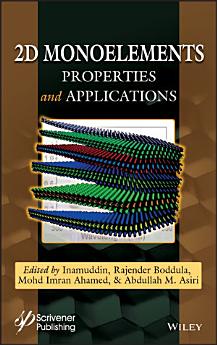
The thematic topics include investigations such as:
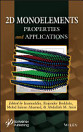
- Recent advances in phosphorene
- The diverse properties of two-dimensional antimonene, of graphene and its derivatives
- The molecular docking simulation study used to analyze the binding mechanisms of graphene oxide as a cancer drug carrier
- Metal-organic frameworks (MOFs)-derived carbon (graphene and carbon nanotubes) and MOF-carbon composite materials, with a special emphasis on the use of these nanostructures for energy storage devices (supercapacitors)
- Two-dimensional monoelements classification like graphene application in field-effect transistors for sensing and biosensing
- Graphene-based ternary materials as a supercapacitor electrode
- Rise of silicene and its applications in gas sensing
વધુ શોધો
લેખક વિશે
Inamuddin, PhD, is an assistant professor at King Abdulaziz University, Jeddah, Saudi Arabia and is also an assistant professor in the Department of Applied Chemistry, Aligarh Muslim University, Aligarh, India. He has extensive research experience in multidisciplinary fields of analytical chemistry, materials chemistry, electrochemistry, renewable energy and environmental science. He has published about 150 research articles in various international scientific journals, 18 book chapters, and 60 edited books with multiple well-known publishers.
Rajender Boddula, PhD, is currently working for the Chinese Academy of Sciences President's International Fellowship Initiative (CAS-PIFI) at the National Center for Nanoscience and Technology (NCNST, Beijing). His academic honors include multiple fellowships and scholarships, and he has published many scientific articles in international peer-reviewed journals, edited books with numerous publishers and has authored twenty book chapters.
Mohd Imran Ahamed received his Ph.D on the topic "Synthesis and characterization of inorganic-organic composite heavy metals selective cation-exchangers and their analytical applications", from Aligarh Muslim University, India in 2019. He has published several research and review articles in SCI journals. His research focusses on ion-exchange chromatography, wastewater treatment and analysis, actuators and electrospinning.
Abdullah M. Asiri is the Head of the Chemistry Department at King Abdulaziz University and the founder and Director of the Center of Excellence for Advanced Materials Research (CEAMR). He is the Editor-in-Chief of the King Abdulaziz University Journal of Science. He has received numerous awards, including the first prize for distinction in science from the Saudi Chemical Society in 2012. He holds multiple patents, has authored ten books and more than one thousand publications in international journals.