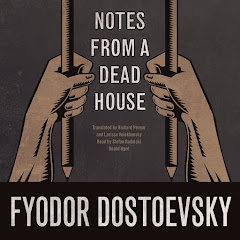
Notes from a Dead House
關於本有聲書
From renowned translators Richard Pevear and Lindsay Volokhonsky comes a new translation—certain to become the definitive version—of the first great prison memoir, a fictionalized account of Fyodor Dostoevsky's life-changing penal servitude in Siberia.
Sentenced to death for advocating socialism in 1849, Dostoevsky served a commuted sentence of four years of hard labor. The account he wrote afterward (sometimes translated as The House of the Dead) is filled with vivid details of brutal punishments, shocking conditions, and the psychological effects of the loss of freedom and hope but also of the feuds and betrayals, the moments of comedy, and the acts of kindness he observed.
As a nobleman and a political prisoner, Dostoevsky was despised by most of his fellow convicts, and his first-person narrator—a nobleman who has killed his wife—experiences a similar struggle to adapt. He also undergoes a transformation over the course of his ordeal, as he discovers that even among the most debased criminals there are strong and beautiful souls. Notes from a Dead House reveals the prison as a tragedy both for the inmates and for Russia. It endures as a monumental meditation on freedom.
瀏覽更多書籍
關於作者
Fyodor Mikhailovich Dostoevsky (1821–1881) was a Russian novelist, journalist, and short-story writer whose psychological penetration into the darkest recesses of the human heart had a profound and universal influence on the twentieth-century novel. He was born in Moscow, the son of a surgeon. Leaving the study of engineering for literature, he published Poor Folk in 1846. As a member of revolutionary circles in St. Petersburg, he was condemned to death in 1849. A last-minute reprieve sent him to Siberia for hard labor. Returning to St. Petersburg in 1859, he worked as a journalist and completed his masterpiece, Crime and Punishment, as well as other works, including The Idiot and The Brothers Karamazov.
Richard Pevear and Larissa Volokhonsky have together translated works by Dostoevsky, Tolstoy, Chekhov, Gogol, Bulgakov, Leskov, and Pasternak. They were twice awarded the PEN/Book-of-the-Month Club Translation Prize (for Dostoevsky’s The Brothers Karamazov and Tolstoy’s Anna Karenina), and their translation of Dostoevsky’s Demons was one of three nominees for the same prize. They are married and live in France.
Larissa Volokhonsky was born in Leningrad. She has translated works by the prominent Orthodox theologians Alexander Schmemann and John Meyendorff into Russian.
Stefan Rudnicki first became involved with audiobooks in 1994. Now a Grammy-winning audiobook producer, he has worked on more than five thousand audiobooks as a narrator, writer, producer, or director. He has narrated more than nine hundred audiobooks. A recipient of multiple AudioFile Earphones Awards, he was presented the coveted Audie Award for solo narration in 2005, 2007, and 2014, and was named one of AudioFile’s Golden Voices in 2012.


